Foundation and Background


Motivation:
Artificial Intelligence is to simulate, as much as possible, human kind of intelligence in machines so that they become capable of assisting us in best possible way. Though Artificial Intelligence has become most popular technological term in last decade but the journey is at least as old as the development of first computing machine.

It is completely inspired by perception by human senses, interpretation by the human brain and control actions by human organs. Mathematical and programmatical models have been developed to make machines learn like human and take decisions much beyond the things presented to them during development.

Now machines are able to defeat world greatest chess champions, recognising complex human languages and scenes, take automatic decisions in difficult manufacturing process, predict business situations etc.

Common Myths/Facts/Observations about AI/ML/DS :
  • AI-ML is very complex knowledge in computational science.
    Fact:It is quite easy and anyone with basic programming knowledge can grasp easily.
  • Only python is AI language and unless you learn it you are not eligible to pursue AI.
    Fact: A few decades ago the same myth was with "Prolog" and "Lisp". No doubt about availability of super rich libraries in Python; But you can realize AI with any language like C/C++/Java also.
  • You need to master mathematical skills like algebra and calculus before you grasp it.
    Fact: A basic high school mathematical understanding is sufficient.
  • We can solve every problem by just training and validation data sets using Deep Learning.
    Fact: One need to understand a domain/problem very well and then only he will be able to use true potential of applied AI-ML. Training and Validation is just one of common steps. You will have to do much more than these for a good solution.
  • A lot of time of all aspirant learners is consumed in teaching just programming language syntax. Moreover, in the name of AI majority is learning just API calls.
    Fact: Library API knowledge is necessary (to use) but not sufficient. If one does not understand the underlying concept, he/she will do random experiment most of the time. Just studying API syntax will never make one confident about solving a particular problem.
  • we have seen people struggling with understanding or defending the differences/similarities among Data-Science, Machine Learning, Artificial Intelligence, Deep Learning, Data-Mining etc.
    Fact: This is most common question which create unnecessary confusion among learners. We recommend, not to argue with "unnecessarily crafted definitions". Artificial Intelligence, Machine Learning, Data Science, Data Mining are practically interchangeable terms. Deep Learning is a new name given to Neural Networks (mostly more than 3 layers) which is one of computational methods used in AI. Here is an [article] providing our open view regarding the same.
  • We need a big infrastructure or very powerful machine to do any AI-ML related experiments.
    Fact: Almost all small or medium size data problems can be solved with just ordinary hardware infrastructure with minimal cost. One just need good efficient programming skills with judicious use of appropriate data structure and algorithms. Unjustified increased cost of cloud/in-house hardware is an indication of inefficient programming skills.
Our Motto:
Simplified Artificial Intelligence: AI is a concept, and even a high school going student can learn it. Any Engineer, Scientist, Manager or Business-person can understand and use it for his/her best benefits. Only thing needed is to get the knowledge in a simple way with real-life examples.

Strength and Specialties


  • Simplification of technical concepts is our innate strength.
  • We teach core detailed concepts and industrial applicability. We do not consume learner's time in teaching Programming Languages' syntax or whole detailed Algebra.
  • We have written almost every single AI/ML algorithm [Earlier in C/C++/Java and now in Python] even without using any ready-made library. Thus, we possess in depth knowledge of all components of AI/ML.
  • We have super rich diversified industry experience spanning various domains with continuous use of AI for more than 22 years. We have invented many granted patents and international IEEE publications in the field of Artificial Intelligence.
  • Our Educational Programs have been designed to make the content very effective, short, interesting and easy with so many examples.
  • We are from tier-1 educational institute (Computer Science from IIT Bombay) – depicting the core capabilities.
  • We provide free post program support for any kind of queries, doubts.
  • Benefit of networking with other people of similar interest.
  • All programs are classroom program conducted in good hotels with excellent infrastructure along with Lunch, Tea-Coffee and Snacks.

Courses on Fundamentals of AI/ML and Computational Science


While serving corporates with our AI/ML education programs, we came across very high demand to conduct short duration programs providing comprehensive and clear understanding of some particular topic[s] around AI/ML. Hence, we designed a few programs, focussed around each topic with detailed information. These programs give kick start to Engineers/Scientists and help them in solving their business/technical problems and make them feeling confident about effective realization of AI/ML in their respective fields.

Program Outline
AI-ML Concept A brief introduction on the evolution of AI/ML
Applications of AI/ML and its impact
General methodology - from real life
Practical Examples of Applied AI
Understanding Data A brief introduction on the evolution of AI/ML
Handling Various Types of Data
Meaning of Dimensions/Features
Feature Importance
Distances - Similarities - Euclidean, Manhattan
Data Clustering Unsupervised Learning
Data Clustering - Applications
Different types of Clustering
K-Means Clustering
Density Based Clustering
Data Classification Concepts Supervised Learning
Training/Validation Data Preparation
Accuracy Measurement - Precision, Recall, F-Measure
Ensembling of Models
Weighted Voting Mechanism
Classification Algorithms
Nearest Neighbours
Nearest Neighbour,
K-Nearest Neighbour, Weighted KNN
Analysis K-Nearest Neighbour
Classification Algorithms
Decision Tree
Sequence of Decisions
Entropy Measurement, Information Gain
ID3 Algorithm - Decision Tree Classifier
Analyzing and Improving Decision Tree
Random Forests
Bayesian Classification Bayes Theorem
Continuous and Discrete Probabilities
Bayesian Text Classification
Binomial & Multinomial Computation
Handling Numeric and Text Data
Analyzing Bayesian Classification
Support Vector Machine Maximum Margin Computation
Support Vector Machine Algorithm
Kernels and Non-Linearity
Neural Networks Neural Networks Introduction
Power of Perceptron
Gradient Descent
Multilayer Perceptron - Neural Networks
Error Backpropagation Algorithm
Important Parameters
Convolutional Neural Networks
Transfer Learning
Complete Working Examples
Recurrent Neural Networks
Natural Language Processing NLP - Introduction
Grammar Rules (English) - Predicates, Clauses
Tokenizing & Stemming
Importance of Punctuations
Handling Acronyms
Part of Speech
Sentence/List Boundary
Word References
Prepositional Phrase
Nouns and Qualifiers
Using Wordnet
Working Examples
Image Processing & Computer Vision Introduction
Image Data Understanding
Image Data Conversion
Filtering Techniques
Transformation
Histogram Equalization
Edge Detection
Morphological Operations
Image Compression
Video Processing
Image Clustering
Image Search and Match
Object Detecting - Localization
Object Tracking in Motion
Use of CNN for Image Recognition
Example: Autonomous Driving (ADAS)
Information Retrieval
Search Engines
Data Collection & Management
Focussed Crawlers
Understanding Indexes
Query Parsing
Spell Correction
Fuzzy Text Search
Boolean & Range Search
Ranking Results
Local & Global Context
Trends & Aging
Personalization
Recommendation Engines Problem Formulations
Collaborative Filtering
Singular Value Decomposition
Netflix Example
Associative Rule Mining
Simple Strategy
Multiple Sources of Data
Incremental Learning
Temporal Trend Analysis
Relevance and Personalization
Time Series Forecasting Understanding Problem & Data
Accuracy Evaluation
Data Cleaning and Smoothing
Single vs Multiple Dimensional Time Series
Trends & Seasonalities
Correlation and Causality
Moving Average Modelling
Auto Regressive Modelling
Neural Networks Modelling
Problem Solving
Data Structure, Algorithms & Complexity
(A very special program needed everywhere)
Problems with Very Large Data
Huge Cost of Computations
Efficient - Insertion, Deletion, Update, Access
Dividing Problems for Distributed Computing
Saving Memory and CPU Cycles
Complexity of Algorithms
Comparing Different Data Structure
Detail Study and Analysis
Set, Linked-List, Array, Map, Hash, Trees, Graphs
Simplified Implementation
Call by Value and Call by Reference
Iteration vs Recursion
Search Algorithms
Sorting Algorithms
Tree and Graph Implementation
Heuristics

Upcoming Programs Schedule


Neural Networks have been in existence and extensively used in almost all major intelligent applications across the world since approx 1960. But they have gain a very huge popularity in last few years, majorly due to:
  • Hardware Development for Parallel Computation
  • Open Source Libraries for Quick Experimentations
  • Simple Infrastructure for Distributed Computing
  • Huge Availability of Knowledge Resources on Internet
Although there are plenty of resources about Deep Learning (Neural Networks) on Internet, still it is very difficult to find ones which are very easy to understand, and capable of making one confident to the level of conveying the same to others. Moreover, once one gets stuck at some point, it is indeed very difficult to find a clear and concise answer.

Keeping that in mind, we have designed a short, intense but very interesting classroom program "Neural Networks (Deep Learning) - Made Super Easy". The core concept is explained with very simple real-world practical examples.


Neural Networks (Deep Learning) - Made Super Easy
Brief Content
Fundamentals of AI and its Facets
Data Preparation for Various Domains
From Single Perceptron to Multi-layer Neural Networks
Application in Business Problems
Efficient Computation for high ROI
Classic and Modern Concepts (Deep Learning)
Convolutional Neural Networks & Transfer Learning

Expected Outcome
  • You will have immense interest in Neural Networks' application.
  • Extremely clear fundamental knowledge about Neural Networks.
  • Ability to evaluate judiciously the problems and use-cases for applicability.
  • Confidence of efficient implementation and use.
  • Ability to bridge between business and technological realization.
Remark:
  • Free: Post Program Email Support for 15 Days.
  • Participation Certificate to All.

Program Will Be Conducted By


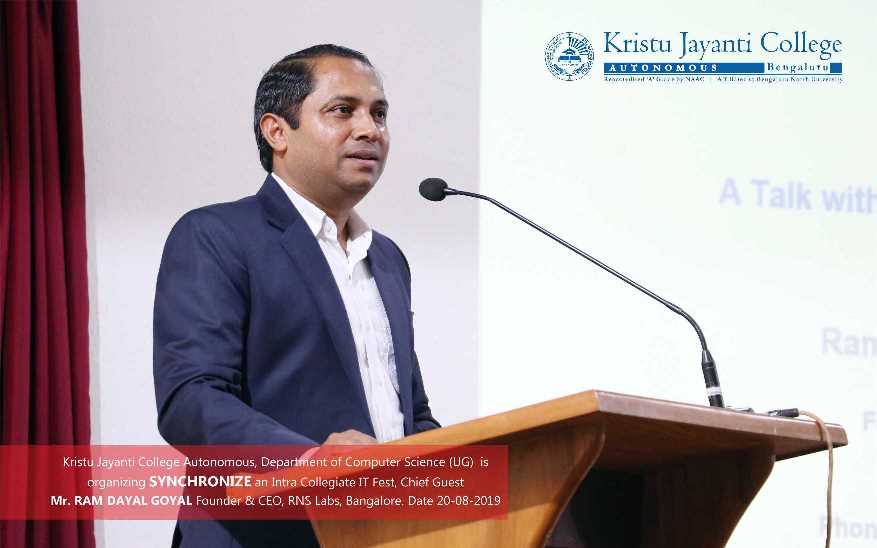
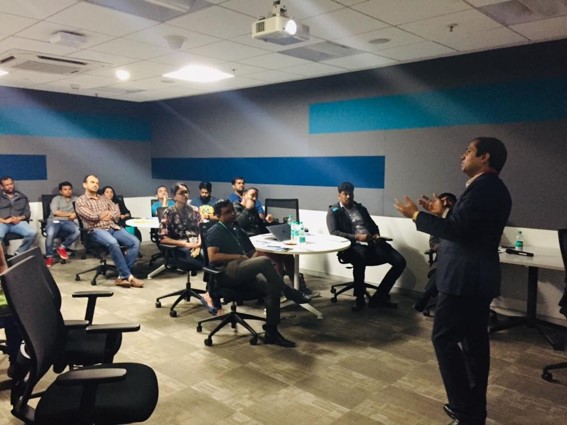
Ram Dayal Goyal
Founder & CEO - RNS Labs Pvt Ltd


  • An IIT Bombay Computer Science alumni.
  • 22+ years of AI-ML industry experience
  • Holding multiple USPTO granted patents in applied AI
  • Multiple international IEEE publications in AI domain.
  • Keynote and invited speaker in many technical/academic forums
  • R&D Head and Consultant for Autonomous Driving, Location Intelligence etc.


  • Earlier Coducted AI Programs at
    • Schneider Electric - Bengaluru
    • Govt. College of Engineering - Pune
    • Hella Automotive - Pune
    • Kristu Jayanti College - Bengaluru
    • Wenger & Watson - Bengaluru
    • Ketera (Deem) - Bengaluru, San Francisco (USA)
    • Rokitt Inc. - New York (USA)
    • Stellapps Tech. - Bengaluru
    • Hindustan Unilever - Bengaluru
    • and many more....


General Day Schedule
9:30 - 10:00 Registration Process
10:00 - 10:30 Keynote and Opening Remarks
10:30 - 11:30 Session 1
11:30 - 12:00 Networking - Tea Break
12:00 - 13:00 Session 2
13:00 - 14:00 Networking - Lunch Break
14:00 - 15:00 Session 3
15:00 - 16:00 Session 4
16:00 - 16:30 Networking - High Tea Break
16:30 - 17:30 Session 5
17:30 - 18:00 Closing Remark


Upcoming events will be published here

Contact us for registration or other query


Please call us at +91-911 080 0039
or
Send an Email to info@RNSLabs.com